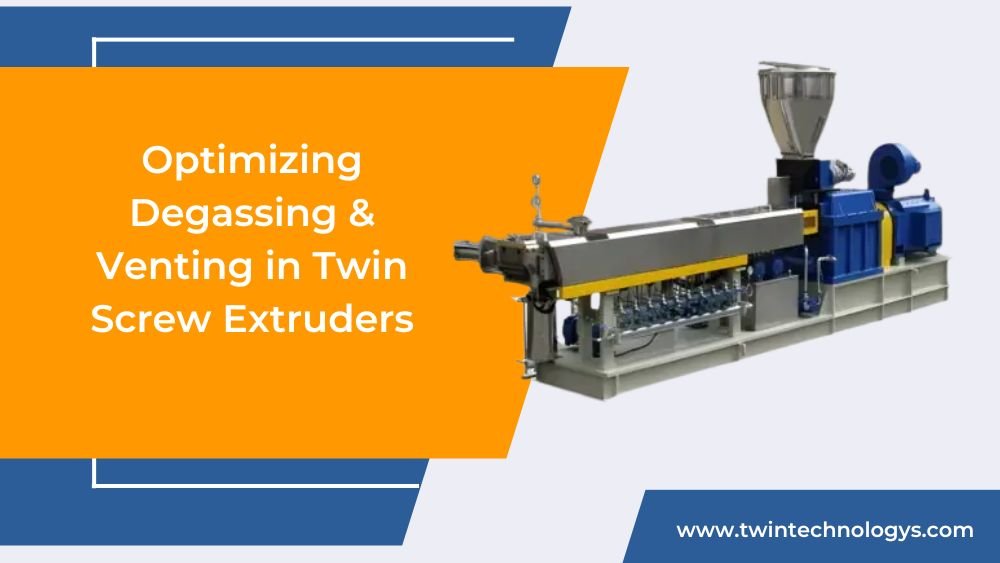
In twin-screw extrusion, the degassing zone is your final line of defense against product defects. If your extruder cannot effectively remove moisture, residual monomers, or entrapped air, the result is predictable: porosity, surface defects, and weak mechanical properties in the final product.
At Twin Technologys, we frequently assist clients in re-engineering their screw configurations to address degassing failures. Here is how to ensure your venting zone is performing at peak capacity.
1. The Mechanics of the Venting Zone
Effective degassing requires a specific screw geometry that creates a “pressure drop” at the vent port.
- The Problem: If the screw elements under the vent port are fully filled with polymer, the material will “clog” the vent, leading to material backup and pressure fluctuations.
- The Solution: You must use “partially filled” elements under the vent. This is typically achieved by using conveying elements with a larger pitch or specialized venting elements that provide the necessary free volume for gas to escape.
2. Preventing Material "Backflow"
A common issue in degassing is material being pulled into the vacuum system. This happens when the screw speed is too high or the pressure seal before the vent is inadequate.
The Seal: Ensure you have effective “sealing elements” (often reverse-pitch kneading blocks or high-pressure conveying flights) placed immediately before the vent zone. This prevents the material from surging forward and helps maintain the pressure gradient needed for vacuum efficiency.
3. Monitoring Your Vacuum System
Even the best screw design cannot compensate for a weak vacuum.
- Maintenance Tip: Regularly check your vacuum lines and traps for buildup. If your vacuum gauge shows a steady pressure but your product still has bubbles, the issue may be a “bridge” of degraded material across your vent port.
- Port Inspection: Clean your vent ports during every major machine shutdown. Any hardened material around the opening acts as an obstruction, reducing your effective pumping speed.
4. When to Reconfigure?
If you are seeing consistent defects despite a clean vacuum system, your screw configuration is likely the bottleneck. You may need to:
- Increase the length of the degassing zone.
- Adjust the stagger angle of your kneading blocks to improve the surface renewal of the melt (this allows gas to escape more easily from within the polymer).
- Add a secondary vent port for high-moisture materials.