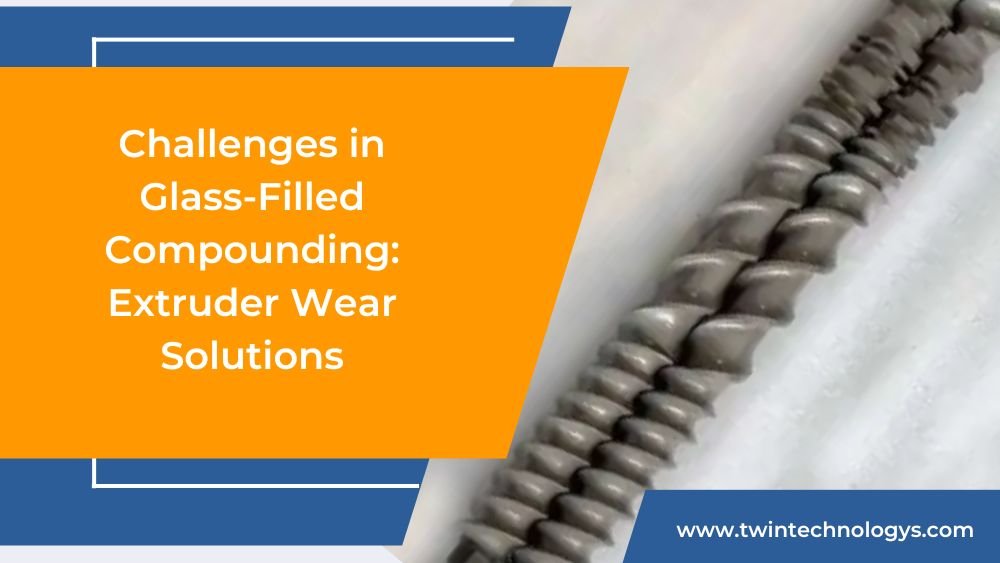
Glass-filled (GF) compounding is a staple in automotive and industrial sectors, providing the high structural integrity required for heavy-duty components. However, for an extruder, glass fiber is one of the most aggressive materials to process. It acts like thousands of microscopic cutting blades, causing rapid erosion of screw elements and barrel liners.
At Twin Technologys, we work with compounding facilities that frequently struggle with “short-lived” components when running GF-heavy formulations. Here is how you can extend your component life and improve your process consistency.
1. The Geometry Factor: Handling Glass Fiber
When adding glass fiber, the “where” and the “how” are critical.
- Downstream Feeding: Never feed glass fiber through the main hopper with the resin. It will be crushed and degraded before it even enters the main melt zone. Use a side-feeder to introduce the fiber into the melt after the resin is fully plasticized.
- Element Selection: Avoid standard mixing elements in the fiber-incorporation zone. Instead, use specialized distributive mixing elements that gently “fold” the fibers into the resin rather than shearing them. This preserves the fiber length, which is vital for the mechanical strength of the final product.
2. Matching Metallurgy to Abrasiveness
Standard nitrided steel will not survive long in a glass-filled environment. You need materials that offer high hardness and high toughness.
- Powder Metallurgy (PM): This is the industry gold standard for GF compounding. PM components maintain their hardness even at elevated processing temperatures, resisting the scoring that glass fibers inflict on standard steel.
- Hardened Tool Steel: If PM is outside your immediate budget, high-grade hardened tool steel is a viable alternative, provided it is sourced from a manufacturer that guarantees consistent core hardness.
3. Monitoring the "Wear Gap"
Glass-filled compounds are notorious for creating “backflow” if the wear gap between the screw and barrel increases even slightly.
- The Impact: Once the gap widens, the abrasive glass particles get trapped in the clearance, accelerating wear at an exponential rate.
- Predictive Maintenance: Implement a strict measurement schedule. If you notice a drop in throughput that cannot be explained by RPM changes, it is almost certainly a sign that your screw elements need inspection or replacement.
4. Improving Surface Finish
A high-quality surface finish is often overlooked in GF compounding. However, a smoother surface finish on your screw flights creates less friction. Less friction means less heat, less material degradation, and ultimately, less wear on the equipment.
Conclusion
Processing glass-filled materials doesn’t have to mean constant downtime for repairs. By utilizing downstream feeding, selecting the correct PM-grade metallurgy, and keeping a close watch on your wear gaps, you can significantly increase the productivity of your extrusion line.